
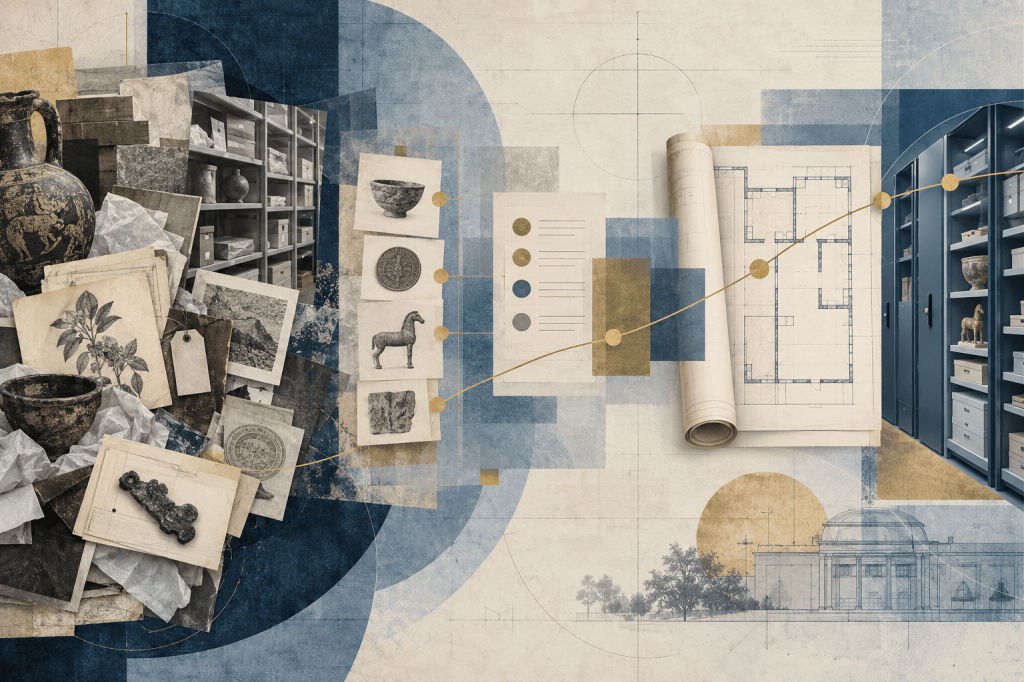
Museums are usually clear about why their collections matter. They are less likely to have a unified plan for addressing everything those collections require.
Needs accumulate across storage, documentation, preservation, staffing, technology, security, access, research, exhibitions, and facilities. Some appear in formal reports. Others remain in budget requests, grant proposals, committee minutes, staff notes, or the institutional knowledge of employees who have learned to work around persistent problems. Without a structure connecting them, the museum can struggle to determine what should happen first, what depends on earlier work, and what resources will be required.
A Collections Master Plan brings those needs into one institutional framework. It evaluates the current collections program, identifies risks and gaps, establishes priorities, and provides a phased path from existing conditions to responsible long-term stewardship. Its scope includes the people, systems, facilities, authority, and resources required to manage collections.
Different Documents, Different Purposes
Museums sometimes use the terms Collections Management Policy, Collection Development Plan, and Collections Master Plan as though they describe the same document. They do not.
The Collections Management Policy establishes the museum’s governing principles and authority. It explains how the institution acquires, documents, cares for, uses, lends, accesses, deaccessions, and disposes of collection material. It defines institutional obligations and identifies who may make particular decisions.
A Collection Development Plan guides the direction of the collection. It assesses existing strengths, gaps, duplication, and collecting priorities. It helps the museum determine what it should actively seek, what it may consider, and what it should generally decline.
The Collections Master Plan examines whether the institution has the capacity to carry out those responsibilities. It identifies what must be corrected, strengthened, phased, or funded across the collections program.
The policy establishes the rules. The development plan guides the collection’s direction. The master plan determines what the museum must build and improve to manage the collection responsibly.
A Collections Master Plan also differs from the institution’s Strategic Plan. The Strategic Plan addresses the direction of the museum as a whole, including its mission, audiences, programs, finances, governance, staffing, partnerships, facilities, and long-term sustainability. Collections stewardship may be one of those priorities, but the Strategic Plan will not ordinarily explain how the museum should correct a cataloging backlog, improve location control, reorganize storage, manage hazardous materials, or prepare records for migration into a new collections system.
The Collections Master Plan applies the museum’s institutional direction to the collections program. If the Strategic Plan calls for greater access, stronger community representation, new exhibitions, increased research use, or broader digital engagement, the master plan identifies what must happen within collections to support those goals.
A Conservation Assessment Plan serves a related but more focused purpose. It evaluates threats to the physical preservation of the collections and may examine environmental conditions, storage furniture, light exposure, pest activity, handling, emergency preparedness, building conditions, and conservation needs.
There is legitimate overlap between the two plans. Both may examine storage, environment, emergency preparedness, and staff capacity. The difference lies in how those findings are used. A conservation assessment asks what the collections physically need to survive. A Collections Master Plan places preservation needs beside documentation, collecting priorities, governance, staffing, technology, access, and funding to determine how the program should develop as a whole.
Those documents become useful to master planning when their recommendations are compared with how the collections program actually operates.
Building the Plan from Institutional Evidence
A Collections Master Plan should be based on more than general impressions or a brief tour of collection storage. It draws from institutional records, collection data, staff knowledge, direct observation, and evidence of how the museum actually operates.
The review may begin with the museum’s mission, Strategic Plan, bylaws, organizational structure, committee charters, previous assessments, and board actions. These records establish institutional priorities, governance, ownership, and decision-making authority. They also show how collections responsibilities have been assigned and whether the formal structure reflects current practice.
The museum’s own collections documents show how those responsibilities have been defined. These may include the Collections Management Policy, Collection Development Plan, acquisition and deaccession procedures, loan agreements, access and reproduction policies, committee minutes, deeds of gift, accession files, rights guidance, and procedures for sensitive or hazardous material. Reviewing them together can reveal gaps, outdated requirements, conflicting standards, or activities that were never formally authorized.
Collection data helps establish the scale of the work. Inventories, catalog exports, accession registers, location records, condition reports, loan lists, rights records, and backlog estimates can show what is known and what remains uncertain. Database manuals and cataloging standards can show whether information is being recorded consistently.
Facilities and preservation records bring the physical environment into the review. Storage layouts, environmental data, pest records, emergency plans, security assessments, hazardous-material inventories, facility reports, and capital plans can reveal risks that may not be evident from a single visit. An existing Conservation Assessment Plan is especially valuable because its findings can be incorporated into broader priorities.
Financial and staffing records help test whether recommendations are realistic. Budgets, grant reports, staffing plans, project schedules, fundraising priorities, and restricted-fund records show what the museum has committed to and what capacity may be available. Research requests, exhibitions, loans, educational activity, digitization demand, and online engagement provide evidence of how collections are used and where access is limited by inadequate documentation or capacity.
The museum does not need to possess every possible document before planning can begin. Missing, outdated, contradictory, or unused records are themselves findings. If the Collections Management Policy identifies one approval process while staff follow another, the difference matters. If the database reports a collection size that no one can verify, that uncertainty should be documented. If a storage plan exists but was never implemented, the planning process should determine why.
The purpose is not to reward the museum for producing paperwork. It is to understand what the institution has formally authorized, what staff actually do, what evidence exists, and where the collections program depends on unresolved assumptions or individual memory.
The review should also test how well the parts of the program work together. A museum may have storage space that lacks suitable shelving, environmental stability, security, or safe access. It may have a collections database filled with incomplete records and inconsistent terminology. It may want to digitize material without sufficient cataloging, rights information, equipment, or staff. It may hold employees responsible for stewardship while giving them little authority to enforce procedures or delay unsafe decisions.
A new facility, database, or digitization initiative cannot resolve these problems on its own. The plan must identify the underlying work needed to make those investments effective.
Establishing the Order of Work
Museums rarely have the resources to address every collections need at once. A master plan becomes useful when it distinguishes urgency from importance and identifies the order in which work should occur.
Some concerns require immediate action because they involve life safety, active deterioration, legal ownership, security, hazardous materials, or an imminent risk of loss. Other needs are foundational. They may not appear urgent, but later projects cannot succeed without them.
A museum may want to conduct an inventory but first need to reorganize storage so objects can be reached safely. It may want to digitize an archival collection but lack sufficient arrangement, description, or rights information. It may plan to relocate collections but need accurate location controls before anything moves. It may seek a new database when the more immediate problem is inconsistent documentation practice.
The consequences of getting that order wrong are practical. An inventory that ignores storage conditions may produce information without improving physical control. A storage project that moves objects without updating their locations may create new confusion. A digitization initiative without rights review or metadata standards may increase exposure without increasing responsible access.
A credible plan makes those relationships visible. It identifies what can begin immediately, what requires additional resources or investigation, and what must wait until earlier work is complete. It should also separate priority from readiness. A recommendation may be critical but not yet ready for implementation because it depends on funding, staffing, facility work, data cleanup, or institutional approval. The need should remain visible even when the museum cannot act on it immediately.
Without that sequence, the master plan becomes a list in which everything appears equally important and leadership receives little guidance about what to authorize or fund.
Defining the order of work also requires a clear boundary around the planning assignment. A Collections Master Plan should not be confused with a complete inventory. An inventory may become a major recommendation, but an item-by-item review can take months or years when objects are inaccessible, poorly labeled, distributed among several facilities, or absent from the collections database. Detailed condition assessments, rights reviews, and potential deaccession projects may require equally substantial work.
Master planning uses available records, staff knowledge, direct observation, and representative sampling to identify where further object-level work is needed. If existing information is incomplete, the plan should define what kind of inventory, assessment, reconciliation, or survey should follow and what resources it will require.
Expecting the planning process to locate, identify, count, condition-check, and reconcile every object creates an unrealistic scope and weakens both efforts. The plan should identify the work and establish how the institution can accomplish it. It should not conceal a major documentation project within a broader planning assignment.
Moving from Findings to Action
Collections documents lose credibility when they establish obligations the institution is unwilling to support. Appropriate storage, reliable documentation, environmental monitoring, conservation, security, digitization, trained handling, and recurring inventory all require resources.
Some improvements can be achieved through clearer authority, revised procedures, staff training, better scheduling, or more effective use of existing systems. Others require new positions, specialized equipment, professional services, facility renovations, or long-term capital investment. A useful plan distinguishes among these needs instead of assuming that every problem requires the same response.
It also recognizes that everything cannot be funded immediately. Recommendations should identify likely costs, dependencies, responsible parties, completion targets, and measures of progress. They can then inform annual budgets, capital planning, grant applications, fundraising priorities, staffing decisions, and technology investments.
Funding and institutional decisions determine whether recommendations can be carried out. Facilities, exhibitions, programs, technology, and acquisitions all affect the museum’s capacity to care for its collections. If collections needs remain isolated within one department, budgets and capital plans may proceed without accounting for those obligations.
The plan should be reviewed regularly. Completed work can be recorded, timelines adjusted, new risks added, and priorities reconsidered as financial or operational conditions change. Accountability does not mean that every original deadline remains fixed. It means that the institution continues to make deliberate decisions and keeps unresolved needs visible.
Implementation also requires named responsibility across the museum. The board, executive leadership, finance, development, facilities, security, information technology, exhibitions, and education may each have a role in a recommendation. A storage renovation needs facilities planning and fundraising; a digitization initiative needs rights review and technical support. A change in collecting priorities can affect staffing, conservation, shelving, and future operating costs.
The plan also protects the museum from excessive dependence on individual memory. Experienced employees often know why an object was accepted, where an unmarked collection is stored, how an old numbering system works, or why a project was postponed. That knowledge can keep an institution functioning, but it is not a sustainable collections system. When those employees retire or leave, undocumented decisions and unresolved work remain behind.
People carry out the work a plan identifies. They need clear authority, resources, and a sequence they can realistically follow.
A Collections Master Plan connects those needs to institutional decisions. It guides immediate action, sets out the work that must follow, and helps the museum understand, preserve, and provide responsible access to the cultural resources entrusted to its care.


Leave a Reply